Digital Art in Lübeck: AI, Games, and Exhibitions
Digital Art & NFT Exhibitions in Lübeck (Preview 2027)
6 min readLaura Müller
How does the cultural experience change when avatars, projections, AI tools, and game mechanics make historical sites readable in new ways? In Lübeck, the focus for 2027 is especially on immersive, interactive, and AI-related formats. This preview compiles reliably announced visiting opportunities and classifies the (likely) role NFTs will play.
Who is this overview for? For visitors who want to experience digital art, game culture, and new mediation formats in Lübeck in 2027—without marketing hype, but with clear guidance for orientation and planning.
What will be especially visible as "digital art" in Lübeck 2027
When people talk about digital art, they mean very different things in practice. For Lübeck in 2027, three main lines are especially relevant, which are typically reflected in programs and exhibition practice:
- Immersive exhibitions with projection, sound design, lighting, and spatial scenography—often as walk-in experiential spaces.
- Interactive formats (stations, labs, playful tasks) where visitors not only observe but act.
- AI as a tool or theme: from curatorial reflection (authorship, bias, data foundations) to practical applications in mediation and design.
These focal points are especially accessible to an audience because they work without specialized knowledge: You can try things out, compare, discuss—and form your own opinion.
Highlight 2027: "Let’s play Middle Ages" – Games, History, and Scenography
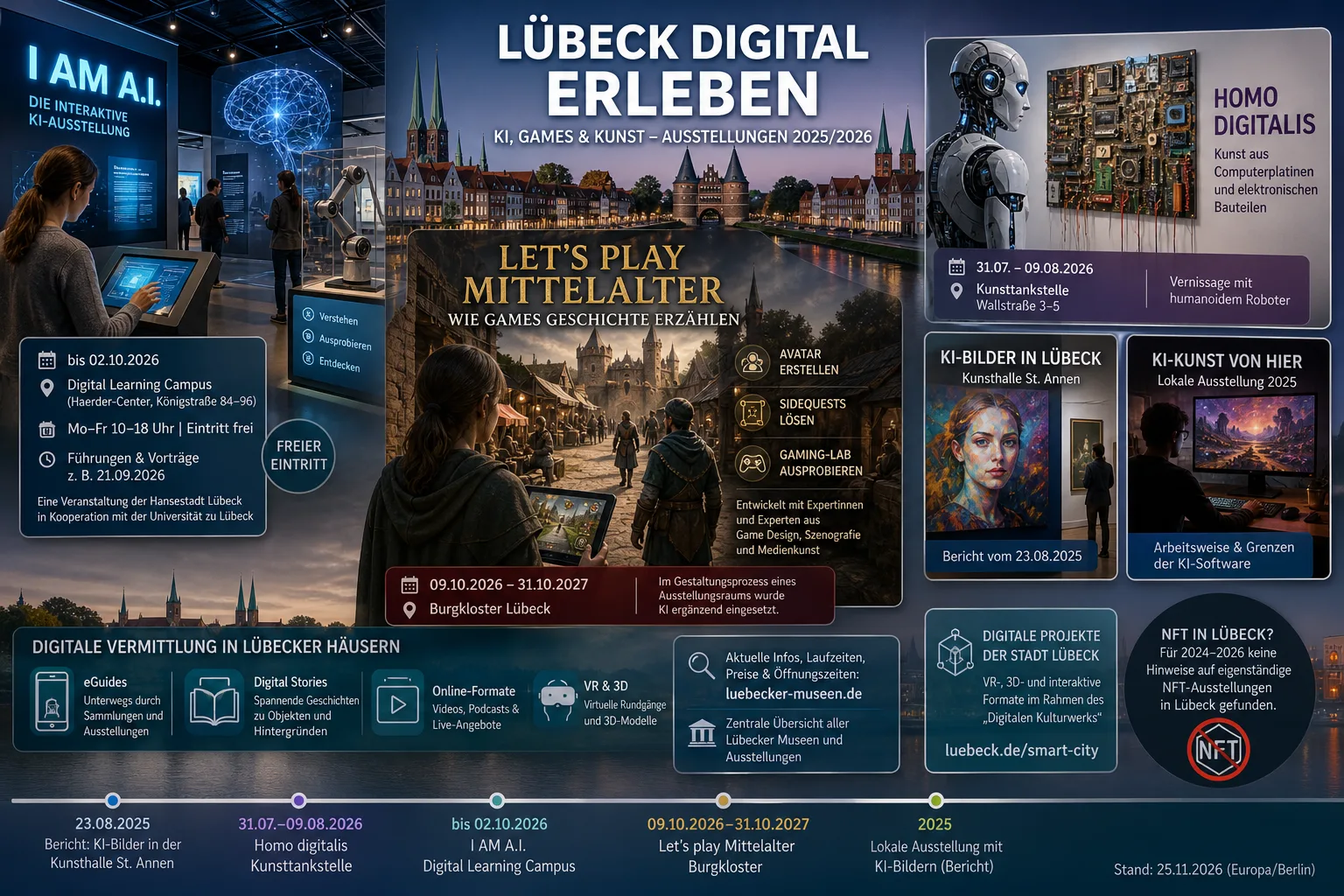
For 2027, one format in Lübeck is especially easy to plan for, as it can be visited over a longer period: The special exhibition "Let’s play Middle Ages. How Games Tell History" at the Burgkloster is announced until October 31, 2027.
What awaits you there in 2027
- Game logics in the museum: Instead of just reading text panels, the idea is to convey history through playful systems (e.g., roles/avatars, tasks, decisions).
- Spaces as "levels": Scenography and media design create a sequence of stations that feel like an exploration.
- Gaming & mediation stations: You can learn about methods by which games shape historical narratives (perspective, reward systems, simplification/abstraction).
This is culturally exciting for Lübeck in particular, as the city is strongly perceived through its historical heritage. In 2027, you can experience how a very traditional place becomes newly "readable" through contemporary media forms.
AI, Interaction, and Museum Mediation: What is Realistically to be Expected in 2027
Even without a single "AI main exhibition," it is easy to classify for 2027 how AI and digital tools typically appear in museum and exhibition practice. It's less about technology and more about concrete visitor questions:
- Authorship & originality: How does the concept of the work change when image, text, or sound elements are partly generated?
- Transparency: Is it made clear if and how AI was used (e.g., in texts, visualizations, mediation)?
- Bias & data foundations: Which perspectives are missing in training data—and how does that affect representations?
- Education instead of hype: What skills do visitors take away (critical examination, source evaluation, contextualization)?
If you want to "read" digital art in Lübeck in 2027 in a targeted way, three simple checkpoints usually help you on site:
- Is it explained how the digital works? Good formats make methods visible (not just effects).
- Is there real interaction? Interaction is more than pressing buttons: It changes your perspective or decision.
- Is responsibility addressed? Serious mediation names boundaries, uncertainties, and open questions.
NFT Exhibitions in Lübeck 2027: What Is (Not) Announced—and Why
Those specifically looking for NFT exhibitions often expect a mix of digital art, blockchain, collector logic, and market mechanics. For Lübeck in 2027, the sober reality is: Independent exhibitions clearly conceived as NFT shows are typically rarer in many local programs than AI, game, or mediation formats.
Why NFTs Often Play a Secondary Role in Public Cultural Institutions
- Curatorial added value: An NFT is primarily a structure of ownership/assignment. For the exhibition experience, it is often more decisive how a work is perceived, explained, and contextualized.
- Audience access: Public institutions often rely on low-threshold mediation. NFT formats are more quickly read as a "market" topic and can exclude parts of the audience.
- Risk and trust issues: NFTs are closely linked to financial topics, platform risks, and forms of fraud. Institutions therefore weigh carefully how to provide orientation without advertising.
- Sustainability debate: Energy and environmental issues around blockchains are a recurring argument in program and procurement decisions (very different depending on chain/mechanism).
This does not mean that NFTs are fundamentally "excluded" in 2027. More realistic than a pure NFT gallery in Lübeck are formats that treat NFTs critically and contextually—for example, as part of a debate about digital authorship, digital goods, and the cultural economy.
Important: If you specifically want to see NFT art in 2027, check the current announcements of local institutions and independent project spaces shortly before your trip. Programs can change at short notice.
Planning Checklist for Your Visit
- Date certainty: Plan around formats with a clear duration (e.g., "Let’s play Middle Ages" until 31.10.2027) and check opening hours in advance.
- Use mediation offers: If tours, labs, or introductions are offered, participation is worthwhile—digital formats are often much easier to access there.
- Accessibility & sensory intensity: Immersive exhibitions often work with light, sound, and projections. If necessary, inform yourself in advance about volume/flickering light notices.
- Bring your own questions: Write down 2–3 questions (e.g., "What here is analog, what is digital?" / "Where is AI in the process?" / "How is transparency ensured?"). This makes the visit measurably more rewarding.