Discover Startups & Innovation Events in Lübeck
Startups & Innovation Events in Lübeck 2026: What Awaits You on June 3–4 on Campus
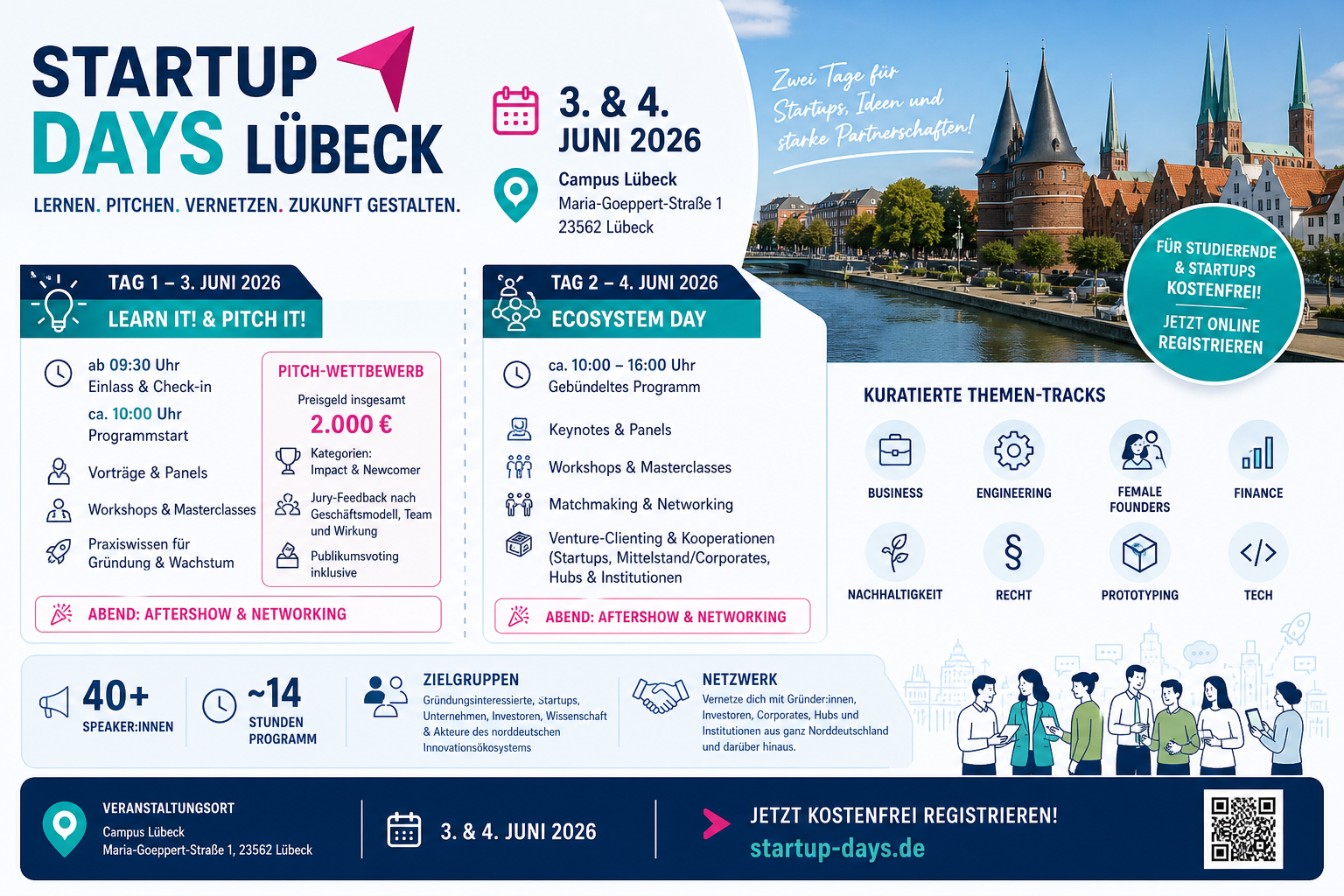
On Wednesday, June 3, 2026, and Thursday, June 4, 2026, a two-day startup and innovation event will take place in Lübeck on the campus at Maria-Goeppert-Straße 1, 23562 Lübeck. If you want to experience the startup scene in 2026, make connections, or showcase your own project, here you’ll get a compact overview of the schedule, formats, typical topic tracks, and hands-on preparation tips.
Important: The following information refers exclusively to this upcoming event and to actions you can plan before the event days.
Dates, Location & Times (Planning Framework)
- Date: Wednesday, 06/03/2026, and Thursday, 06/04/2026
- Location: Campus, Maria-Goeppert-Straße 1, 23562 Lübeck
- Entry (Day 1): approx. 09:30 am
- Program Start (Day 1): approx. 10:00 am
- Day 2 (combined): approx. 10:00 am–4:00 pm (including networking and exchanges around the program)
- Participation: Online registration required in advance; students and startups can participate free of charge according to the announcement (each after prior registration).
For your travel planning, it’s worth consciously scheduling a buffer on the first day: check-in, orientation on campus, and the first conversations typically happen before the official start.
Program Overview: Formats & Expectations
A packed program is announced for the two-day event, including:
- Talks/Keynotes (impulses, perspectives, practical reports)
- Panels (discussions with several participants)
- Workshops/Masterclasses (interactive, with concrete methods and Q&A)
- Pitch formats (short, pointed presentations of startup ideas)
- Networking (breaks, matchmaking-like conversations, follow-up contacts)
If you set a goal in advance (e.g. “3 suitable contacts for pilot projects”, “feedback on the pitch deck”, “find a mentor”), you’ll use the two days much more efficiently.
Day 1 (June 3, 2026): “Learn it! & Pitch it!”
The first day is focused on founding knowledge, practical learnings, and pitch moments. Curated topic tracks are expected, helping you quickly decide which sessions fit your status (idea, MVP, first customers, growth).
Typical Topic Tracks (how to choose)
- Business & Finance: Business model, financing, key figures, investor logic.
- Engineering & Tech: Product development, architectural decisions, prototyping approaches.
- Female Founders: Networking, visibility, perspectives, and concrete hurdles in founding practice.
- Sustainability: Impact-oriented models, impact logic, communicating impact.
- Law & Structure: Legal forms, contract basics, data protection and IP issues.
- Prototyping & Innovation: MVP thinking, user feedback, iterative approaches.
How to Get the Most Out of Workshops & Masterclasses
- Bring a concrete question (e.g. “Which key figure should my pitch show first?” or “How do I prioritize MVP features?”).
- Bring 2–3 artifacts (digital is enough): one-pager, pitch deck draft, landing page/prototype link.
- Plan at least one session per day that isn’t “your” topic—this often leads to unexpected aha moments (e.g. law/data protection if you’re from tech).
Pitch Competition: How to Prepare
A pitch competition is announced as the program highlight on the first day. The framework includes a total prize money of 2,000 euros, among others in the categories “Impact” and “Newcomer”. An audience vote is also planned.
Pitch Check (2026-ready, in 10 Minutes Preparation)
- Problem: In one sentence—who is it painful for and why now?
- Solution: What exactly are you delivering (product/service) and what is the benefit?
- Proof: Traction, pilot interest, prototype, user feedback (even small, but concrete).
- Market: Who pays, how is it bought (B2B/B2C), rough size without fantasy numbers.
- Competition: Name alternative(s) and clearly differentiate.
- Business Model: How do you make money—explain simply.
- Team: Why you can credibly implement this (roles + relevant experience).
- Impact (if relevant): What measurably improves, how do you avoid greenwashing.
- Ask: What do you need after the event (pilot customer, mentoring, investment, co-founder)?
- Conclusion: A clear reminder (claim + contact option).
Audience Voting: How to Make It Easier for Yourself
If an audience vote is planned, a simple rule helps: Make it easy for people to find you again. This works with a memorable name, a clear value proposition, and a QR code leading directly to a short landing page (with contact and “book next conversation”).
Day 2 (June 4, 2026): “Ecosystem Day”
The second day is announced as “Ecosystem Day” and focuses more on cooperation: startups, SMEs, larger companies, hubs, universities, and public actors meet to initiate collaboration in a structured way.
Topics You Can Typically Expect
- Venture Clienting: Collaboration where companies use startups as suppliers/partners for innovation.
- Cooperations & Programs: Partnerships (regional to international), funding logic, and project setup.
- Matchmaking: Formats that specifically bring together suitable contacts.
- Best Practices: Case studies on pilot projects, procurement processes, scaling, and governance.
If You Represent a Company (SME/Corporate)
- Define 2–3 concrete problems in advance (e.g. process digitization, data integration, sustainability reporting, automation).
- Formulate what you can offer: Pilot budget, test environment, data access, decision-maker meeting, reference.
- Plan an internal “fast lane”: Who is allowed to make a pilot decision within 10 days after the event?
If You Represent a Startup
- Prepare a pilot offer (scope, duration, rough efforts, success criteria).
- Clearly state what you need: access to users, process data, test customers, integration partners.
- Be prepared for procurement and compliance questions (data protection, information security, contract framework).
Who Should Attend (2026)?
- People interested in founding: If you’re looking for orientation (testing an idea, next steps, avoiding typical mistakes).
- Startups: If you want visibility, feedback, pilot contacts, or to kick off recruiting.
- Students: If you’re looking for team/project ideas or want to test founding as a career option (including free participation after registration).
- Companies: If you want to find innovation partners, start pilot projects, or attract talent.
- Investors & Mentors: If you want to get to know deal flow/teams in a compact format.
Checklist: Preparation Before the Event
1–2 Weeks Before
- Complete registration and keep confirmation handy.
- Set a personal goal: learn, pitch, pilot, recruit.
- Write a short introduction (30 seconds): Who are you, what are you working on, who are you looking for?
- Prepare materials: one-pager, pitch deck (short version), demo/prototype link.
1–2 Days Before
- Block appointments: travel with buffer, consciously reserve breaks for conversations.
- Set contact points: Which sessions/tracks fit your goal?
- Test business card or digital contact option (e.g. QR code).
On the Event Day
- Arrive early (especially day 1) and use the first conversations at check-in.
- Take structured notes: “Contact”, “Follow-up action”, “Deadline”.
- After every good conversation: agree on the next step immediately (call, demo, pilot scoping).
On Site: Networking Strategy in 6 Steps
- Start with context: “Are you here for day 1 (Learn & Pitch) or day 2 (Ecosystem)?”
- Qualify quickly: Role (startup/company/investor/student), search goal, decision-making proximity.
- Give value first: Introductions, tools, tips for suitable sessions.
- Ask about the hurdle: “What is currently the bottleneck—customers, tech, law, funding?”
- Keep it short: 5–8 minutes are enough for a good first contact.
- Follow up within 48 hours: Message with context (“We spoke after session X about Y”) + concrete suggestion (15-minute call).
Sources & References
- European Commission: Data Protection in the EU (GDPR Overview) — Background for typical data protection questions in pilot projects and collaborations (accessed 2026-05-20)
- BMWK: EXIST – Start-ups from Science — Overview of founding context and funding logic often discussed in startup programs (accessed 2026-05-20)
- BSI: Federal Office for Information Security — Guidance on information security, often required in B2B pilots (accessed 2026-05-20)