Discover Children's University and Science Events in Lübeck
Children's University & Science Events in Lübeck (Upcoming Dates): How Families Can Find the Next Hands-On Opportunities
Hands-on science works best when it takes place regularly: as a lecture for children, as a student lab day, as an astronomy evening, or as a city format where you can try things out yourself. This guide helps you reliably find upcoming Children's University and science events in Lübeck and select them according to age, interest, and time window.
For whom? Families, grandparents, teachers, and anyone who wants to attend science events for children and young people in Lübeck soon.
Which Formats Typically Come Up Next in Lübeck
For the coming months, several types of science events are usually announced in Lübeck. Which of these are currently available depends on the respective semester, holiday periods, and program cycles. Most frequently published are:
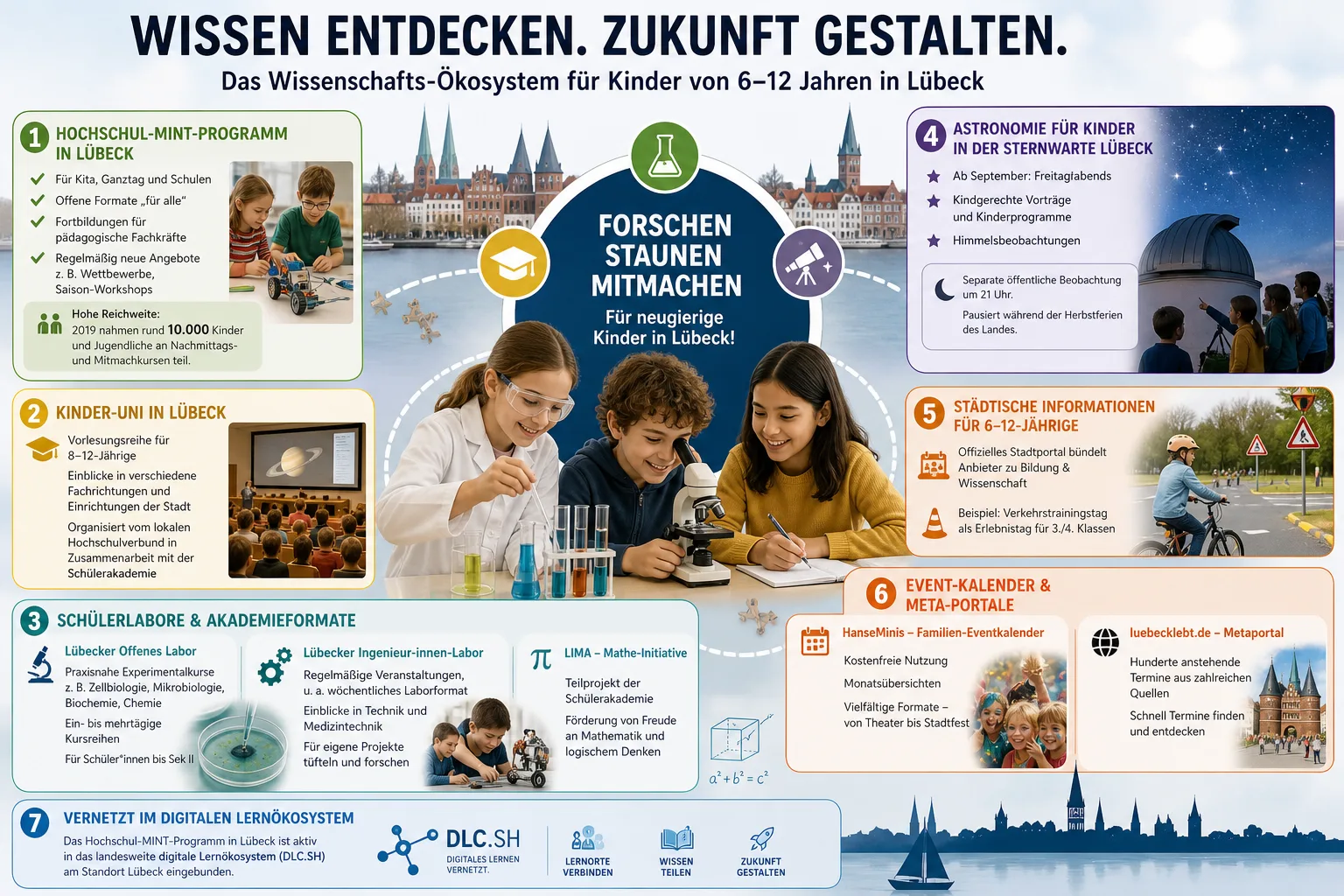
- Children's University Lectures (multiple dates as a series, usually with registration)
- Student Labs (lab days or course blocks in biology, chemistry, technology/engineering, etc.)
- Open STEM Workshops (e.g., programming, experimenting, environmental or technology topics)
- Astronomy Evenings (family formats and public observations, weather-dependent)
- City and Holiday Formats (hands-on activities, action days, occasionally linked to cultural or educational programs)
Important for planning: The specific dates, age groups, and participation conditions are always listed in the official announcements. Preferably use university and city websites as well as established regional event portals (see Step-by-Step).
Children's University: How to Find and Select the Next Lecture Series
The Children's University is established in many cities as a lecture format for children: Scientists explain a topic in a child-friendly way, often with experiments or vivid demonstrations. For Lübeck: New series are usually announced as upcoming dates on university websites or in joint event overviews.
How to Select Suitable Children's University Dates
- Check age indication: Many Children's University offers are aimed at specific grades (often elementary to early secondary school). Only choose dates that explicitly match the age group.
- Compare format: Some dates are pure lectures, others combine talks and hands-on activities. For first visits, a shorter, highly interactive format is often ideal.
- Registration & places: For series, individual dates fill up quickly. Plan ahead and check if accompanying persons are allowed.
- Accessibility & arrival: Check location, admission times, and accessibility information (if provided) in advance.
If you are planning as a teacher: Look for information on group registrations and whether there are supplementary materials or notes for preparation and follow-up.
Student Labs & STEM Courses: How to Plan the Next Lab Date
Student labs differ from classic workshops: They are usually more closely tied to lab practice, safety rules, and experimental procedures. That is exactly what makes them so valuable for children and young people—because things are possible there that are often difficult to implement in everyday school life.
What to Consider for Upcoming Student Lab Dates
- Topic area: Check whether the offer covers biology/chemistry, computer science, technology/engineering, or mathematics.
- Duration: Some dates are advertised as project days, others as multi-part series. Multi-part events are worthwhile if your child wants to "stick with it" for longer.
- Prerequisites: Grade level or basic knowledge is often specified. Stick to this so that your child can keep up in the course.
- Safety: Lab offers often mention clothing instructions (e.g., sturdy shoes, tie back long hair) and rules—plan for this for the date.
Good Questions Before Registering (for Upcoming Dates)
- Is participation free of charge or is there a fee?
- Is the event for children only or with an accompanying person?
- Are there waiting lists or alternative dates?
- How is cancellation handled in case of illness or inability to attend?
Observatory & Astronomy Evenings: What to Watch Out for at Upcoming Observation Nights
Astronomy events are a classic among science events—and at the same time highly dependent on weather, visibility conditions, and seasonal darkness. For upcoming observatory dates in Lübeck: Rely on the current event page of the observatory or the organizing association/operator and check for short-term updates.
How to Make the Next Observatory Visit Plannable for Families
- Distinguish event type: Some evenings are explicitly family- or child-friendly, others are aimed at a general audience.
- Plan for weather updates: On the day of the event, check whether observation is possible or if an alternative program will take place.
- Time & tiredness: Especially in winter, suitable observation windows start earlier; in summer it can get dark very late. Choose according to your child's stamina.
- Expectation management: Not every night shows "spectacular" things. Often the highlights are the moon, planets, or star clusters—and these are absolutely worth seeing.
Science in the City: Upcoming Activities, Hands-On Stations, and Learning Locations
In addition to university formats, upcoming science events are often also visible through city channels, educational initiatives, or cultural programs. This is especially worthwhile for families, as these dates are often low-threshold: short hands-on stations, action days, or formats that combine learning with movement and everyday experience.
If you are specifically looking for the next suitable date, filter in calendars by:
- "Hands-on", "Workshop", "Experiment", "Lab" (common keywords)
- Age group (e.g., 6–8, 8–12, from 12)
- Location (city center, campus, district, museum/institution)
- Holiday programs (additional STEM offers often appear here)
Step-by-Step: How to Find the Next Dates (Calendars, Newsletters, Portals)
-
Check official university websites. Start with the websites of Lübeck's universities and look there for "Children's University", "Student Lab", "STEM", "Outreach" or "Events".
-
Check the observatory/association website for current announcements. For observation evenings, short-term updates are crucial (weather, visibility, changes).
-
Use city and regional portals as a supplement. Event calendars help if you are searching "on the weekend" or "during the holidays"—always check the detail page of the organizing institution.
-
Activate newsletters/notifications. Many institutions publish new series first via newsletters or news sections. This is the best way not to miss the next spots.
-
Double-check before booking. Do age, location, duration, costs/fees, accompanying rules, accessibility, and cancellation conditions match?
If you have several children of different ages: Make a small favorites list (2–3 providers + 1 portal). This reduces search effort and increases the chance of finding suitable upcoming dates in time.