Social Projects in Lübeck: Engagement, Education, Health
Social Projects & Initiatives Moving Lübeck (Outlook)
Which social initiatives are coming up next in Lübeck, and how can residents, students, and visitors get involved meaningfully in the future? This article compiles expected project areas, typical ways to participate, and points of orientation – with a focus on upcoming dates, new formats, and planned collaborations.
Sports & Exercise: Planned Formats with Social Value
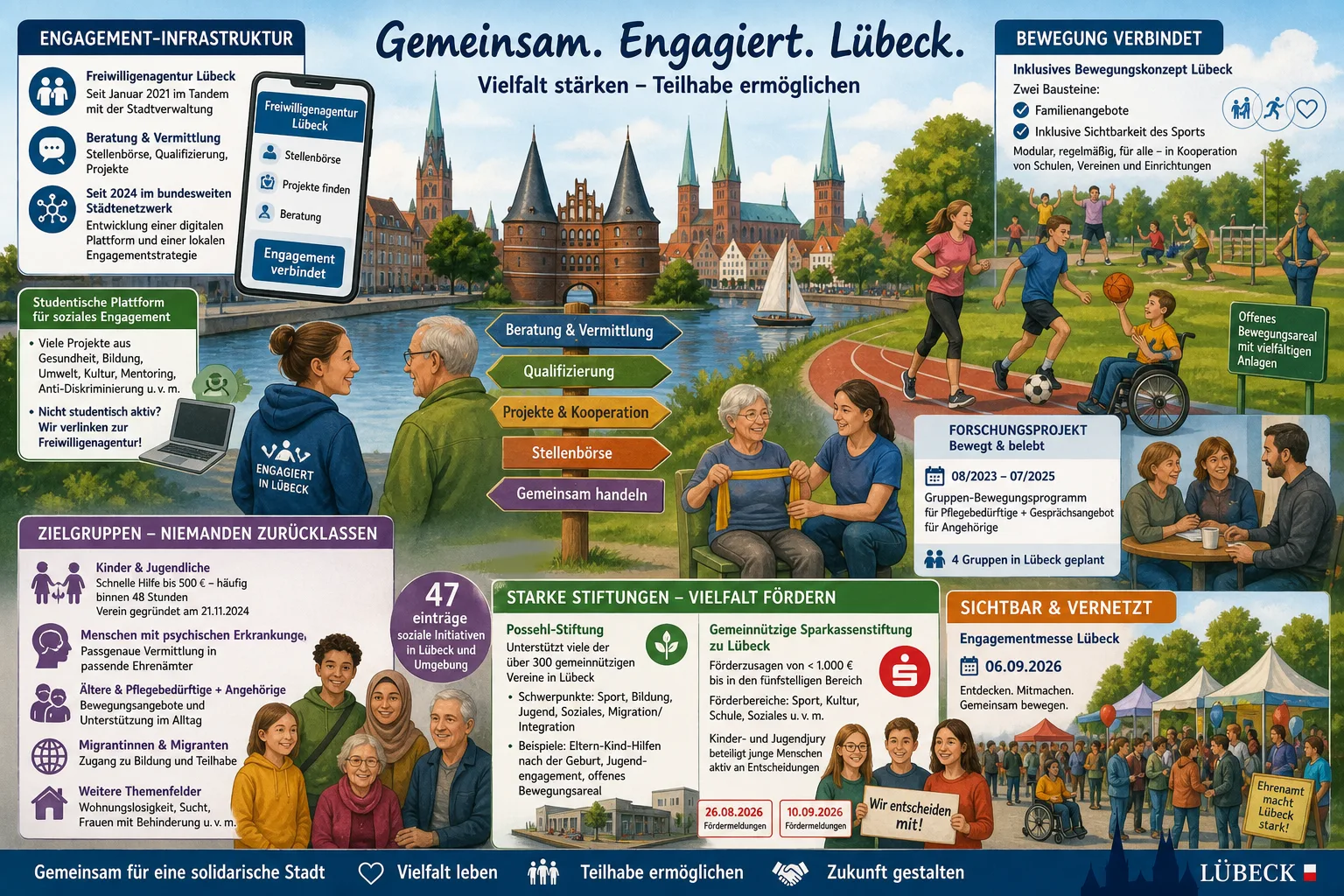
In the near future, many municipalities – and thus likely also Lübeck – can expect an expansion of low-threshold exercise offerings: open meetups, walking groups, inclusive sports sessions, exercise offers for families, and age-appropriate courses. The social effect arises not only from training, but above all from encounter, reliability, and participation.
Which Formats Will Be Especially Meaningful in the Coming Months
- Open Exercise Times in the Neighborhood: without club membership, with low-barrier access and flexible participation.
- Inclusive Groups: Offers that address people with and without disabilities together (e.g., adapted exercise variants, calm settings, clear procedures).
- Exercise Plus Conversation: Combination of activity and moderated exchange (e.g., for relatives, single parents, or people in transition phases).
What to Watch for Regarding Health
Exercise offers are particularly trustworthy when they clearly communicate who they are suitable for, what intensity is planned, and how health limitations are handled. If you are unsure, a brief consultation with your doctor is advisable before starting a more intensive program.
Note: This article does not replace medical advice and makes no individual health promises.
Funding & Foundations: How New Projects Are Created
In the upcoming funding landscape, two types of support typically play a central role – and both are particularly relevant for Lübeck as a city shaped by foundations: strategic funding (larger programs over a longer period) and micro-funding (small, quick amounts for immediate needs).
What Will Prove Effective for Funding Applications in the Near Future
- Clear Target Group: Who exactly does the project in Lübeck reach (e.g., young people in the neighborhood, seniors, immigrants, caregiving relatives)?
- Concrete Impact: What change is realistically measurable or understandable (e.g., regular meetings, participation numbers, feedback, new collaborations)?
- Implementation Security: Who takes on coordination, representation, and documentation? How is data protection handled?
- Sustainability: What happens after the project ends (continuation, handover, follow-up funding, institutionalization in the association/provider)?
If you are planning a project yourself, a two-step approach often helps: first a small pilot phase (4–12 weeks), then an evaluation, and then a larger application for continuation.
Target Groups in Focus: Which Offers Are Likely to Grow
Children and Young People
In the coming school semesters, projects with a low entry threshold and a clear role are especially in demand: learning support, mentoring, media literacy, democracy education in everyday life, support during transitions (school–apprenticeship/university), as well as leisure activities with reliable reference persons.
For engagement with minors: Pay attention to protection concepts, fixed contact persons, clear rules for communication, and transparent procedures, especially when digital channels are used.
People with Mental Health Challenges
In the near future, the demand for suitable, resource-conserving engagement is likely to continue to rise: tasks with clear boundaries, plannable times, and supportive accompaniment. Good projects offer choices (e.g., more organizational, creative, practical, social) and respect limits without pressure.
If you are affected yourself: Starting with short, manageable activities is often sensible. Reputable organizations accept that availability can fluctuate and help define tasks realistically.
Older and Care-Dependent People
For the coming months, two types of offers are particularly effective: (1) encounter and exercise groups in local settings and (2) relief offers for caregiving relatives that combine exchange, information, and low-threshold support.
Engagement in this area is trustworthy when it is linked to instruction, clear boundaries (no care activities without qualification), and reliable coordination.
Migrants and Participation
In the coming quarters, offers that facilitate orientation and enable contacts are particularly important: language cafés, learning mentorships, accompaniment to authorities (within clear rules), application assistance, encounter formats in neighborhoods, as well as cultural and sports offers as door openers.
Good practice: simple language, multilingual information, reliable dates, and cooperation with local providers.
Neighborhood, Culture & Education: Upcoming Impulses for Everyday Life
Neighborhood & District Development
In the near future, projects that enable encounters without much effort are particularly effective: neighborhood cafés, exchange and repair formats, joint cooking or gardening meetups, small help networks (e.g., accompaniment, shopping, sharing routes), and low-threshold actions in squares or district centers.
Such initiatives work best when they have fixed times, share responsibilities, and make rules for respectful interaction (including protection against discrimination) transparent.
Culture and Education as Bridges
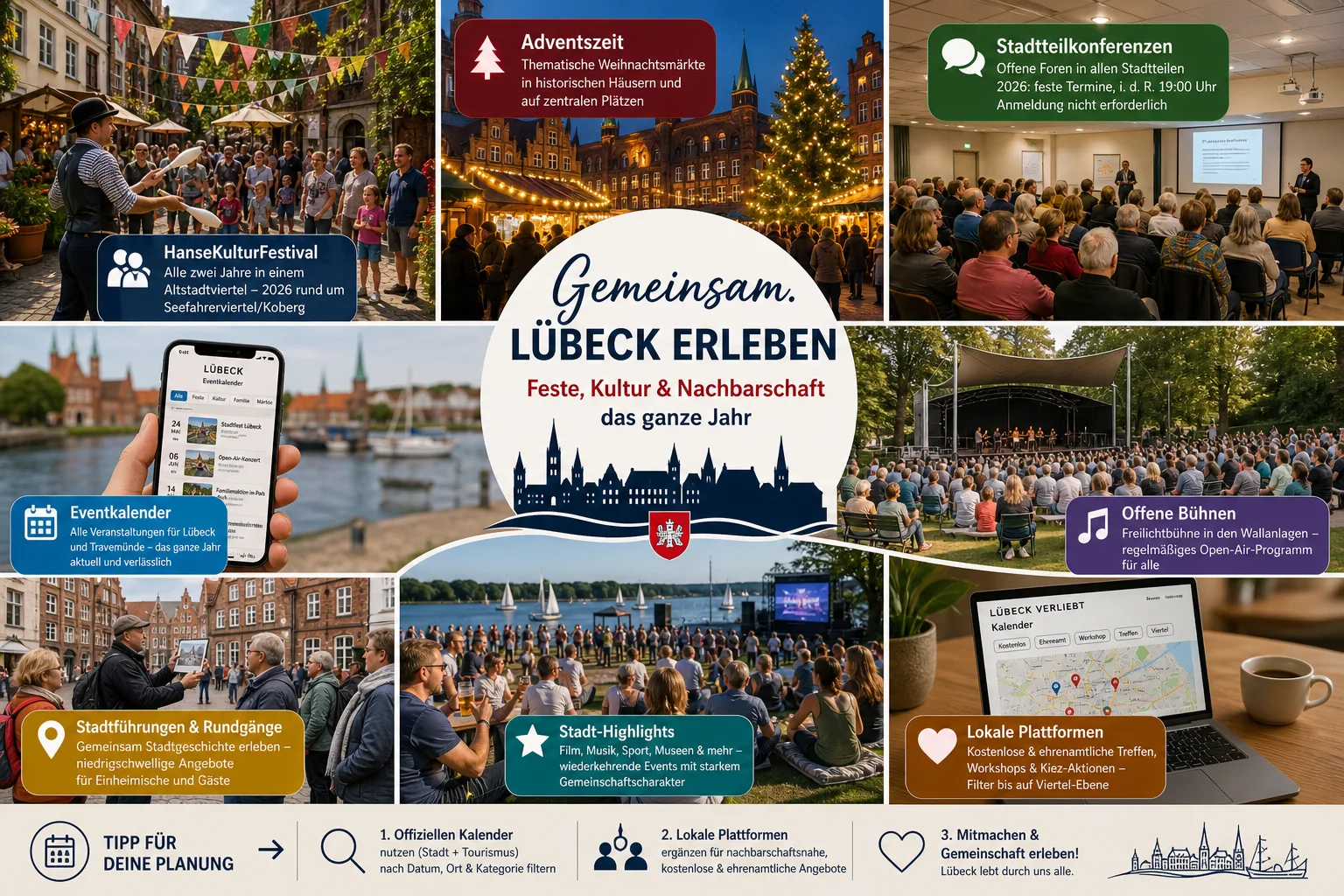
In the coming season, cultural formats are particularly suitable for bringing together people who otherwise rarely come into contact: joint workshops, open stages, exhibitions with dialogue formats, district archives, or intergenerational storytelling cafés. Educational offers often complement this with practical skills (media, language, everyday knowledge, career orientation).
If you want to offer a format yourself, your chances of success increase if you actively lower barriers: free participation, short distances, low-barrier locations, clear times, understandable language, and cooperation with local institutions.
Get Involved: Practical Steps for Your Future Engagement
- Choose a time commitment that remains realistic even in stressful weeks. Reliability is often more important for projects than scope.
- Decide on a topic that has personal meaning for you. Typical fields in Lübeck are neighborhood, education, culture, sports/exercise, participation, and social support.
- Check the framework conditions. Is there an introduction, insurance coverage, contact person, clear task description, data protection rules?
- Start with a getting-to-know phase. A trial appointment or a limited assignment (e.g., several weeks) helps you get started without being overwhelmed.
- Document impact simply and honestly. Short notes on participation, feedback, and obstacles help later with funding and improvement.
If you are new to Lübeck or only staying for a limited time: Ask specifically about short-term, project-based assignments (e.g., events, action days, seasonal offers). This is often the fastest way to make contacts and still help reliably.
Sources
- World Health Organization (WHO): Physical activity – Fact sheet — Background on health effects and recommendations (accessed 2026-09-16)
- BMFSFJ: Engagement and Society — Overview of engagement promotion and framework conditions in Germany (accessed 2026-09-16)
- Federal Government: Social Cohesion — Classification of why local participation and engagement structures are socially relevant (accessed 2026-09-16)
- Destatis: Society & Environment — Statistical background on the social situation (accessed 2026-09-16)