How Lübeck is Changing – Discover New Cultural Venues
How Lübeck Will Change – New Cultural Venues and Ideas
7 min readLaura Müller
What happens when a city no longer sees its department stores, streets, and warehouses merely as places for shopping and parking, but as stages for education, culture, and everyday life? In Lübeck, several projects are being planned to test exactly this: right in the old town, along the Trave, and in side streets that could take on new roles.
City Center in Transition: From Department Store to “Third Place”
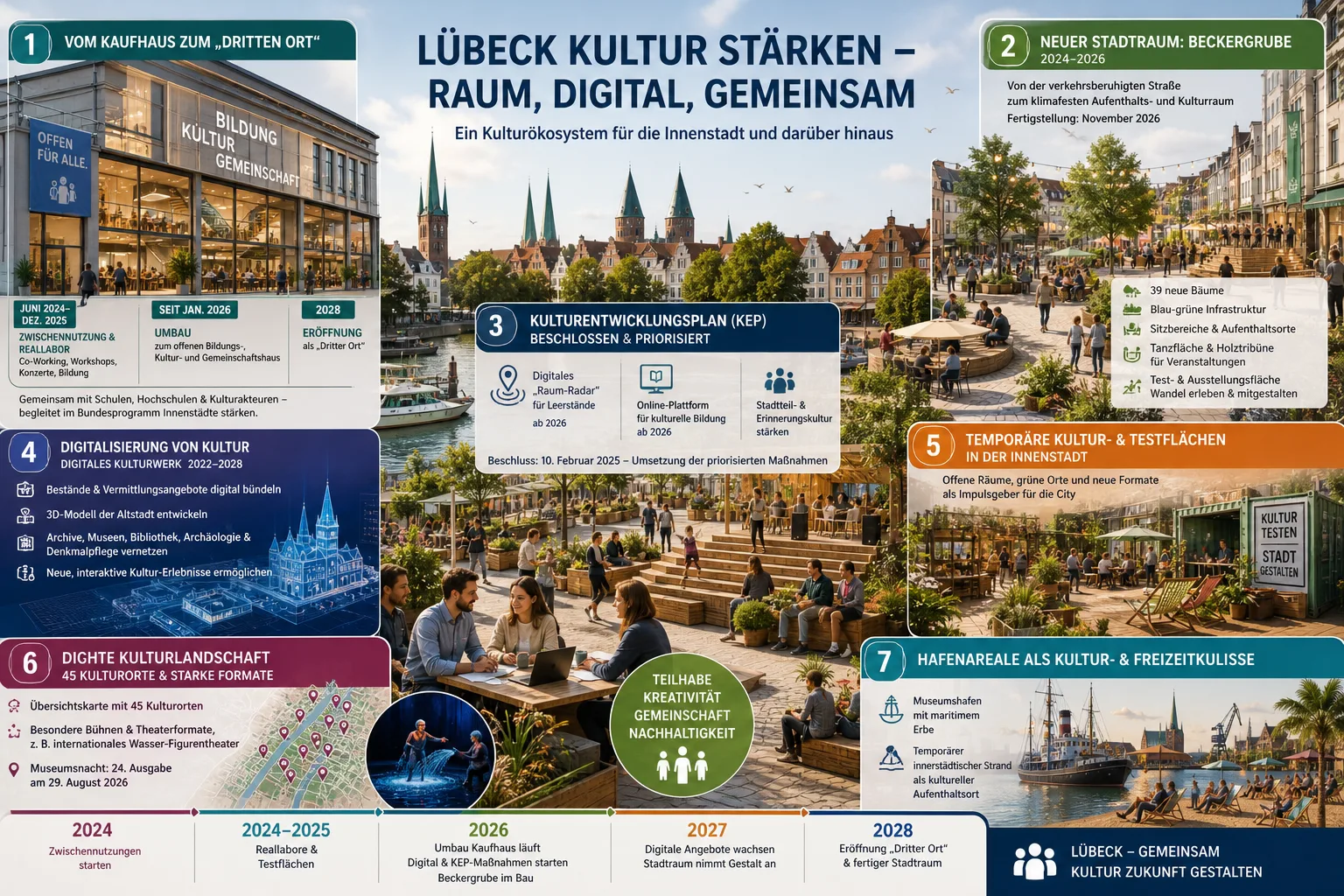
A central building block for Lübeck is the question of how large inner-city properties can be used in the future. When retail spaces shrink or shopping behavior changes, opportunities arise for new uses: education, culture, encounters, and low-threshold places to stay. The term “Third Place” describes exactly such spaces between home and workplace, where people can come together without the pressure to consume.
For Lübeck, this primarily means examining whether existing buildings in the old town can be converted or reinterpreted so that they are open, flexible, and used in a mixed way. Such projects are often complex, because monument protection, economic viability, accessibility, and program quality must all fit together. At the same time, they are attractive for historically grown cities because they further develop existing substance instead of sealing new areas.
Beckergrube: Street Becomes Climate-Resilient Cultural and Recreational Space
In parallel with building concepts, the street space is also being re-evaluated in many cities: less as a pure traffic area, more as a public living space. For the upper Beckergrube in Lübeck, a redesign is being discussed and planned that aims to combine climate adaptation, quality of stay, and culture.
Announced or frequently mentioned elements of such measures include additional trees, seating areas, rainwater management (“blue-green infrastructure”), as well as clearly defined areas for events. In Lübeck, the idea of a dedicated area for cultural formats is also mentioned – for example, as a dance or performance space with grandstand-like seating.
If Beckergrube functions more as a place to stay in the future, this can have several effects: better heat regulation through greenery, more space for pedestrian traffic, new impulses for gastronomy and retail, as well as additional opportunities for district and neighborhood events.
Cultural Development Plan: Compass for Lübeck’s Cultural Landscape
Individual projects have a more lasting effect when they are linked by strategy and implementation steps. In Lübeck, cultural development is structured in this sense by a Cultural Development Plan (KEP), which is intended to bundle guidelines and prioritized measures for the coming years.
Digital Tools for Spaces and Offerings
As concrete instruments, such programs often plan digital overviews that make cultural spaces, vacancies, or temporarily usable places visible. A “space radar” can, for example, serve to bring together available spaces and usage ideas – so that cultural formats can start more quickly instead of failing due to a lack of information.
In addition, a central online platform for cultural education can be created, making the offerings of various providers findable: for schools, families, seniors, clubs, and individuals. The benefit lies less in “yet another website,” but in bundling: clear filters, understandable categories, and a common entry point lower barriers.
Culture as a Cross-Section: Districts, Remembrance, Public Space
To ensure that cultural development is not only visible in the city center, district-based formats, smaller project funding, and artistic interventions in public space are usually also considered. Especially in a city with a strong historical heritage, dealing with remembrance culture can also become an important building block – as a program, not just as a one-off event.
Digital Cultural Work: Experience Lübeck in a 3D Model
In addition to physical locations, digital cultural infrastructure can also shape how a city is perceived and used in the future. For Lübeck, a “Digital Cultural Work” is described as a project that aims to network archives, museums, libraries, archaeology, and monument preservation more closely and expand digital mediation.
The possible centerpiece is considered to be a 3D city model of the old town, which can link building and urban space data with collections and stories. If such a model is implemented, typical use cases are:
- Education: Virtual explorations, thematic city tours, and teaching materials that are spatially anchored.
- Mediation & Tourism: Context for buildings, time layers, and collection objects – also independent of opening hours.
- Planning & Monument Preservation: Visualization of future changes, better coordination between stakeholders, more comprehensible trade-offs.
The curatorial perspective is important here: The added value does not arise from technology alone, but from reliable metadata, comprehensible sources, and content that is told across institutions.
Interim Uses, Harbor Areas, and Existing Cultural Venues (Outlook)
Whether culture “arrives” in the city is often decided between the major projects: through flexible formats, temporary uses, and places where new things can be tried out. For Lübeck, it can be expected that interim uses and test areas will continue to play a role in the future – especially where vacancies, ground floor zones, or transitional situations allow for quick, reversible solutions.
Harbor and waterfront areas are also frequently mentioned as spaces with development potential. If cultural offerings become more visible there, the connection between the city, waterfront location, and maritime identity can become more tangible – for example, through small stage formats, exhibitions in urban space, or seasonal programs that activate walking paths and recreational areas.
At the same time, the impact of the new projects can benefit from the fact that Lübeck already has a diverse cultural landscape. If these existing venues are systematically integrated into program planning, communication, and visitor guidance, a cultural ecosystem emerges: established institutions, the independent scene, temporary formats, and digital offerings complement each other instead of standing side by side.
What This Change Could Mean for Lübeck
The projects mentioned follow (in their logic) three guiding ideas that are relevant for many historic cities – and which can fit together particularly well in Lübeck:
- Rethinking Existing Properties: Former retail spaces can become places for education, community, and culture – as a contribution against mono-functions in the city center.
- Activating Public Spaces: Streets and squares can be designed to be both climate-adapted and culturally usable – with quality of stay as a basic prerequisite.
- Expanding Digital Infrastructure: Platforms, space overviews, and 3D models can create access, network content, and make decisions more comprehensible.
For residents, this can create an everyday life in which culture is less of an “event” and more of an “environment”: places to belong, participate, and learn. For visitors, Lübeck can thus be experienced, in addition to its famous brick silhouette, as a city of contemporary culture – with formats that not only allow consumption, but also participation.
What will be crucial is how transparent the implementation is, how low-barrier the offerings are, and how permanent the structures are designed to be. If this succeeds, Lübeck can become an example of how culture, climate resilience, and digitalization can be thought of together in a UNESCO-influenced old town, without covering up the historic character.