
Jakob Böhme
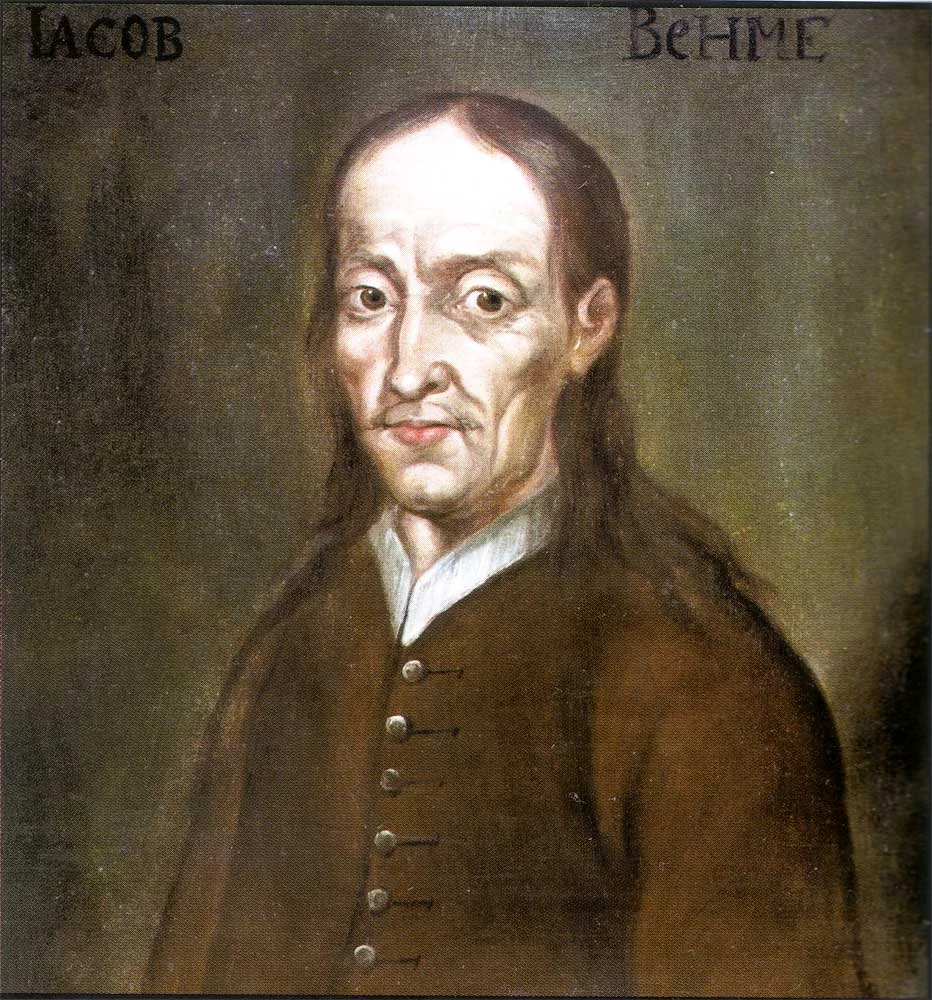
Image from Wikipedia
Image from Wikipedia
Jakob Böhme: The Visionary Thinker from Görlitz and His Radical Language of Inner Experience
A Life Between Craft, Revelation, and Spiritual Explosiveness
Jakob Böhme, also known as Jacob Böhme in contemporary terms, was born in 1575 in Alt Seidenberg near Görlitz and died on November 17, 1624, in Görlitz. He was a shoemaker, mystic, philosopher, and Christian theosopher – a rare combination of practical life and spiritual radicalism that continues to make his work extraordinary today. Georg Wilhelm Friedrich Hegel referred to him as the "first German philosopher" because he was one of the first to write significant philosophical texts in German. ([de.wikipedia.org](https://de.wikipedia.org/wiki/Jakob_B%C3%B6hme?utm_source=openai))
His spiritual significance did not arise from an academic environment but from intensive, self-taught engagement with religion, nature, and inner experience. It was precisely this independence that shaped his thought and made him an early controversial figure in the Protestant milieu of his time. In the history of ideas, Böhme does not stand on the fringes but at a hinge point between the Reformation, mysticism, early Enlightenment, and German ideal philosophy. ([deutschlandfunkkultur.de](https://www.deutschlandfunkkultur.de/jacob-bohme-mystiker-100.html?utm_source=openai))
The Early Years in Görlitz: Craft as the Source of Spiritual Authority
Böhme grew up in Upper Lusatia and worked as a shoemaker in Görlitz. This biographical grounding in craft is more than a historical footnote; it also explains the tone of his writings: direct, vivid, simultaneously grounded in earthliness and charged with metaphysics. He was neither a court scholar nor a university philosopher, but a thinker whose authority stemmed from experience, self-observation, and vision. ([en.wikisource.org](https://en.wikisource.org/wiki/1911_Encyclop%C3%A6dia_Britannica/Boehme%2C_Jakob?utm_source=openai))
His first major spiritual upheaval culminated in a work later known as Aurora or The Dawn Rising. The text emerged from a series of enlightening and breakthrough experiences and marked a rupture with ecclesiastical authority and orthodox thinking. Even this early work demonstrates the core of Böhme's thought: the conviction that the divine is not only experienced in doctrines but also in the inner structure of the world and humanity. ([deutschlandfunkkultur.de](https://www.deutschlandfunkkultur.de/jacob-bohme-mystiker-100.html?utm_source=openai))
The Breakthrough with the “Dawn”: Vision as Intellectual Provocation
The Dawn Rising was Böhme's actual breakthrough – and simultaneously a scandal. A copy fell into church hands, was confiscated, and Böhme received a writing ban. This initiated the tension that has accompanied his work to this day: Böhme wrote out of inner compulsion but against institutional boundaries, and from this emerged the urgency of his language. ([deutschlandfunkkultur.de](https://www.deutschlandfunkkultur.de/jacob-bohme-mystiker-100.html?utm_source=openai))
The reactions of his time demonstrate the explosive power of his thoughts. In Görlitz, he came under pressure, and his writings were not read as harmless piety but as a challenge to the theological order. That he continued to work nonetheless is due to the energy of his texts, which were interpreted by readers as spiritual revelation, by opponents as provocation, and by later thinkers as a philosophical ignition. ([encyclopedia.com](https://www.encyclopedia.com/people/philosophy-and-religion/protestant-christianity-biographies/jakob-boehme?utm_source=openai))
Works and Thought Style: Theosophy, Philosophy of Nature, and the Language of Contrasts
Böhme's thought revolves around central questions of theodicy, the relationship between good and evil, light and darkness, love and wrath, freedom and necessity. German biographies and encyclopedic accounts emphasize that he understood these contrasts not merely morally but as fundamental movements of reality. This led him to develop a form of language that is simultaneously theological, philosophical, and poetic. ([deutsche-biographie.de](https://www.deutsche-biographie.de/sfz5003.html?language=de&utm_source=openai))
His most important writings include, besides the Dawn, works like The Three Principles, On the Threefold Life of Man, On the Incarnation of Christ, and Mysterium Magnum. In scholarly research, these are considered key texts of a Christian mysticism that rethinks the relationship between God, nature, and humanity. His thoughts are not systematic in the academic sense but possess an inner composition that continues to fascinate with its metaphorical density and conceptual boldness. ([encyclopedia.com](https://www.encyclopedia.com/people/history/german-history-biographies/jacob-boehme?utm_source=openai))
Style and Language: Why Böhme is Considered an Early German Philosopher
Böhme's particular significance also lies in his language. Hegel praised him as the first German philosopher because he articulated philosophical content in German rather than resorting to Latin. This decision not only made him more accessible to later readers but also gave his thinking a distinctive rhythm, where religious imagery, nature metaphors, and speculative terms intertwine. ([de.wikipedia.org](https://de.wikipedia.org/wiki/Jakob_B%C3%B6hme?utm_source=openai))
Several sources describe him as an original thinker within the Lutheran tradition, whose early writings caused great excitement. His works became famous not for academic elegance but for their spiritual intensity, their vivid imagery, and their willingness to push thought to the limits of the expressible. Böhme does not speak in smoothly polished formulas but in a language that struggles, seeks, and transforms vision into concept. ([en.wikipedia.org](https://en.wikipedia.org/wiki/Jakob_B%C3%B6hme?utm_source=openai))
History of Influence: From the Quakers to German Philosophy
The impact of Jakob Böhme extends far beyond his lifetime. Wikipedia and encyclopedia sources cite influences on Christian mystical and anti-authoritarian movements, including Quakers, Philadelphians, Gichtelians, the Society of the Woman in the Wilderness, the Ephrata Cloister, and the Harmony Society. Thus, a Silesian-Lusatian shoemaker became a thinker of international spiritual resonance. ([en.wikipedia.org](https://en.wikipedia.org/wiki/Jakob_B%C3%B6hme?utm_source=openai))
Even in the philosophy and literature of the 18th and 19th centuries, Böhme remained present. German biographies and cultural-historical contributions refer to his recognition by Hegel and his relevance for romantic and speculative thought. Even where his texts are not directly quoted, his model of an inner, cosmically charged thought continues to resonate. ([deutsche-biographie.de](https://www.deutsche-biographie.de/sfz5003.html?language=de&utm_source=openai))
Relevance Today: Why Jakob Böhme is Still Read
The ongoing engagement with Jakob Böhme shows that his questions are by no means outdated. He negotiates the relationship between freedom, order, guilt, nature, and transcendence in a way that still challenges contemporary readers. Precisely because he wrote not from academic distance but from existential experience, his texts retain a remarkable immediacy. ([deutschlandfunkkultur.de](https://www.deutschlandfunkkultur.de/jacob-bohme-mystiker-100.html?utm_source=openai))
Current institutional references to projects and initiatives surrounding Jacob Böhme also demonstrate that his name remains culturally relevant. At the same time, there are no official social media channels for the historical figure in the modern sense; the tradition lives on through texts, research institutes, editions, and cultural-historical mediation. For an audience seeking spiritual depth, linguistic intensity, and philosophical independence, Böhme remains an extraordinary voice in European intellectual history. ([jacob-boehme.org](https://www.jacob-boehme.org/de/Einzel-Initiativen.html?utm_source=openai))
Conclusion: A Thinker Who Breaks Boundaries
Jakob Böhme is fascinating because he presents thought not as an academic discipline but as an existential experience. From the life of a shoemaker emerges a work of world-historical significance that uniquely connects mysticism, philosophy, and language. Reading Böhme does not confront the reader with a smooth system but with a spiritual movement full of tension, depth, and contradiction. That is his greatness – and that is why the encounter with his work remains worthwhile today. ([deutsche-biographie.de](https://www.deutsche-biographie.de/sfz5003.html?language=de&utm_source=openai))
Official Channels of Jakob Böhme:
- Instagram: No official profile found
- Facebook: No official profile found
- YouTube: No official profile found
- Spotify: No official profile found
- TikTok: No official profile found